"Se tu m'ami"
#24 of "Thoughts on the 24 Italian Songs"

And so, we reach the last of the “24.” The reason this is last, of course, is because we have been going chronologically, and it’s believed that this was actually composed not by Pergolesi, but rather by Parisotti himself.
Something I only recently learned was that doubts about the authenticity of this piece go back to at least 1949! (Walker, Frank. “Two Centuries of Pergolesi Forgeries and Misattributions.” Music & Letters, vol. 30, no. 4, 1949, pp. 297–320. JSTOR, http://www.jstor.org/stable/730672. Accessed 24 Aug. 2025.)
In his edition, Paton simply lists Parisotti as the composer. While I agree it is possible, if not likely, that Parisotti composed this forgery, I would not go so far as to say that is established fact. I continue to list it as “attr. Pergolesi.” I remember reading in Opera News that there was a veritable Pergolesi forgery “industry” in the 19th century, and exactly 10% of the works attributed to him are authentic. (33 out of 330.) I would consider it at least a possibility that Parisotti was fooled by a convincing fake. See the fascinating article, Murata, Margaret. “Dr Burney Bought a Music Book...” The Journal of Musicology, vol. 17, no. 1, 1999, pp. 76–111. JSTOR, https://doi.org/10.2307/764012. Accessed 24 Aug. 2025.
[Dr. Murata has done some great work on the arie antiche, and I have been corresponding with her about this project!]
So, what to do with “Se tu m’ami”? As we have seen, it remains one of the most often assigned and sung of the “24.” It was the title track on Cecilia Bartoli’s best-selling arie antiche project. For me, I think it’s fine to assign, so long as we all acknowledge what it is, a 19th-century piece written to evoke a Baroque style, not too unlike Donaudy’s Arie di stile antico.
There is one EGREGIOUS mistake in the “24 Italian Songs” edition, and unfortunately, it comes in an already difficult spot:
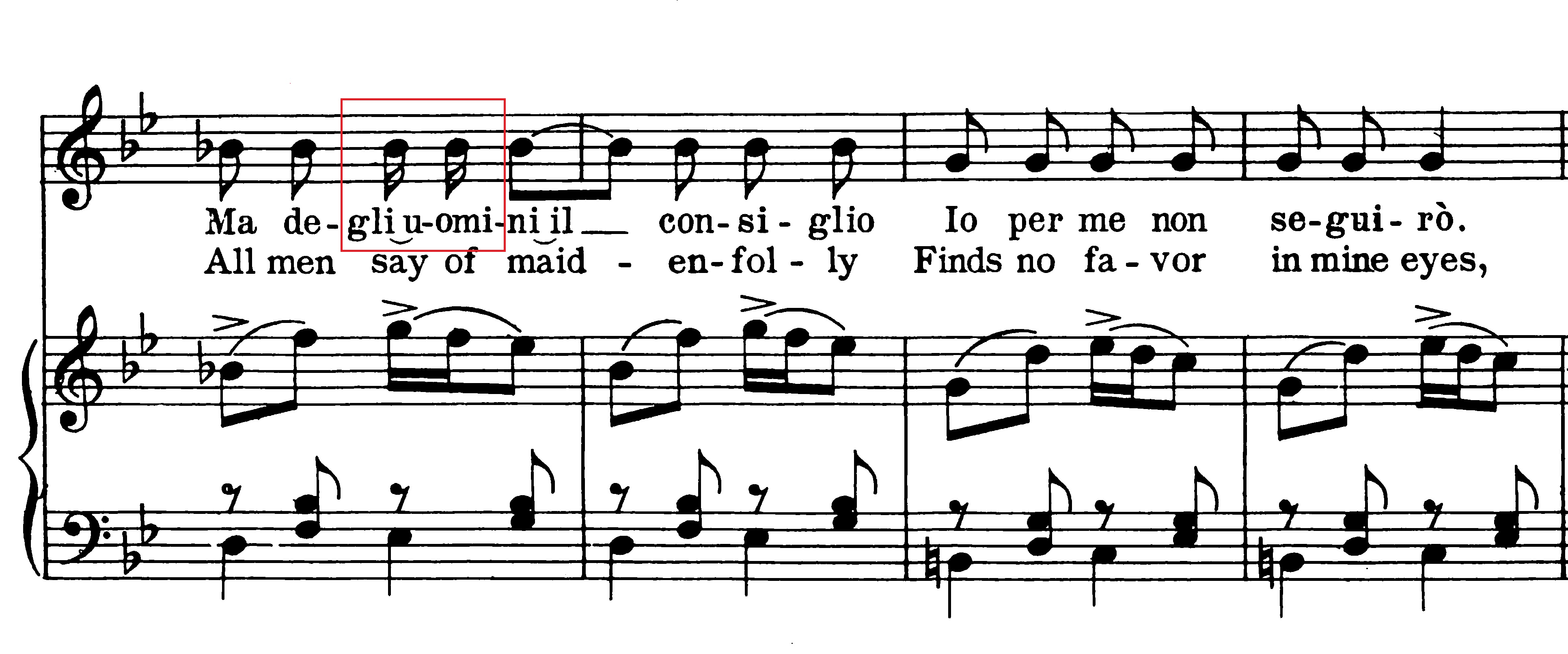
Of course, the syllables should be divided: “Ma de-gliuo-mi-ni il…” The way it appears here is quite impossible!
Text underlay issues like that are common in 19th century publishing. English speakers expect syllables to fall directly under the note to which it corresponds. Italians were either sloppy or assumed that everyone would know that seven syllables of poetry would correspond to seven notes.
There’s another giveaway that this song isn’t by Pergolesi. The first line of the song includes an extra syllable not in the original poem. The line should be “Se tu m’ami, sei sospiri”. It’s an ottonario. Someone (Parisotti?) added the world “tu” making it a nine syllable line. That meter is almost never used in Italian poetry and never (at least not that anyone studying this has ever found) in opera libretti. Yes, composers sometimes repeat a line or part of a line, but this kind of alteration, not unheard of in German Lieder, is not typical (I know of no other examples) in Italian text setting, at least in the 17th and 18th centuries. (Things get a little looser starting with Boito.)
I do assign it. It’s a useful song to teach sinalefe (the joining of vowels across words as one syllable in the poetry and on one note of music). If they can do it in this song, hey will have no trouble when this shows up in arias and recitatives.